Reference build — our own system
The knowledge base that files itself
Everyone wants the second brain everyone on tech Twitter keeps describing. We built ours and have run it every day since April. An agent reads each source, writes the page, extracts the people and the ideas, and connects them — so the context is there before you ask for it.

Client
None — our own system
Field
Knowledge management
Built
April – June 2026, ~11 weeks
Runs on
Claude Code + Obsidian, Markdown in Git
369,654 words of our own context — already written up, linked and quotable. You don't paste that into a prompt. It is simply there.
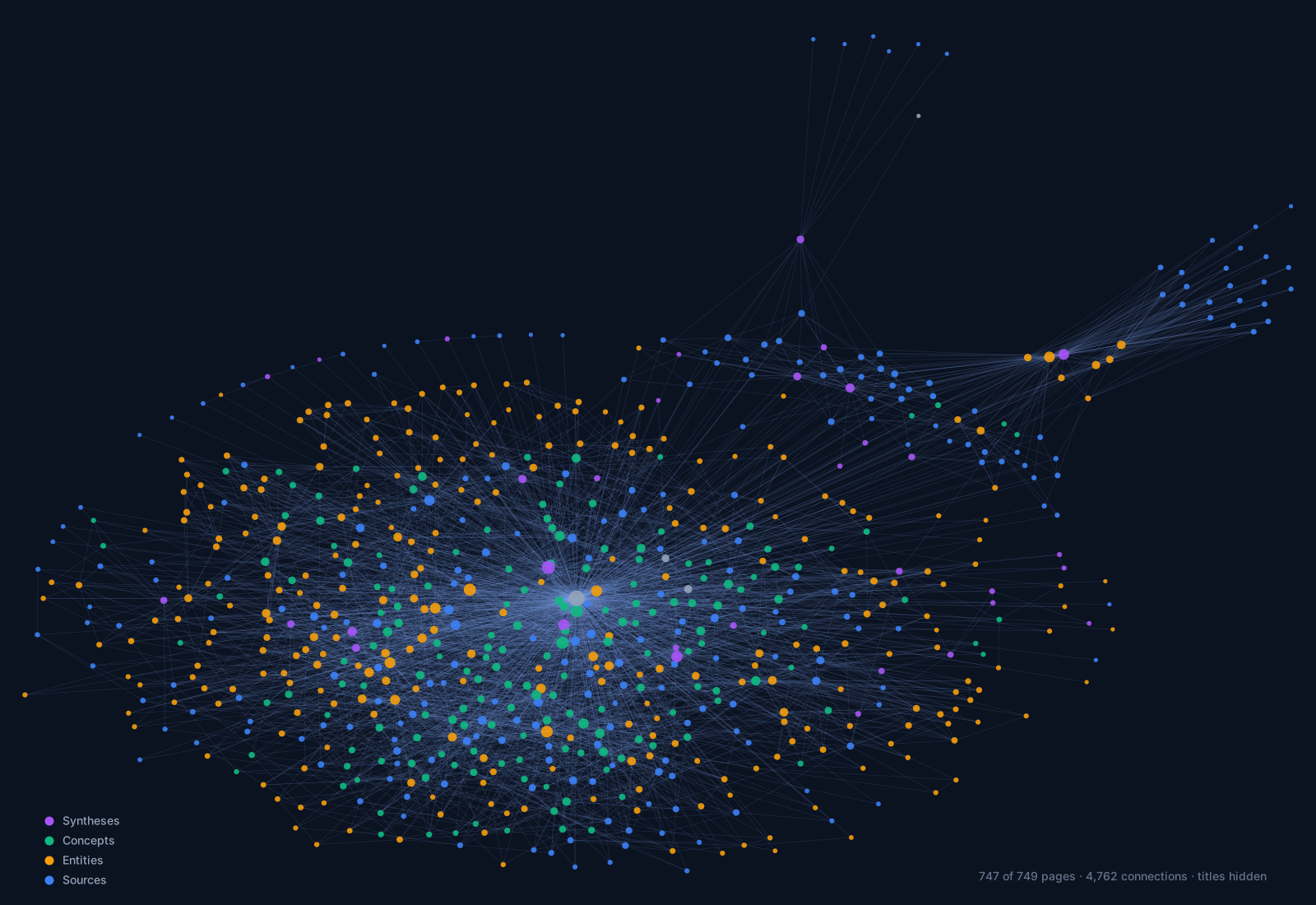
- 749pages the agent maintains245 sources · 295 entities · 171 concepts · 33 syntheses
- 369,654words of context already written uproughly 690,000 tokens
- 15,028links the agent wrote4,762 of them between existing pages
- 4pages connected to nothingout of 749 — the linking actually happens
The problem: context does not survive the conversation
Every session with a language model starts from nothing. You find the note again, paste the relevant part again, explain the background again. The thinking is not the expensive part — the reassembly is, and you pay for it several times a day.
The usual fix is to pile everything into one folder and hope search saves you. It doesn't: a folder of 900 files is not context, it's a haystack with better lighting.
What we built
A schema file turns Claude Code into a librarian with rules: how a page is structured, when to cite, what to link, what never to touch. You drop a source in and run one command. The agent reads it, writes a summary page, pulls out the people, companies and ideas it mentions, gives each of them a page of their own, and links all of it together.
No RAG and no vector database. The whole brain is Markdown in a Git repository, which means every change the agent makes is a diff you can read and roll back, and the same files open natively in Obsidian — where the links become a graph you can walk.
- 20 commands — ingest, query, deep answers with citations, lint, synthesis, contradiction hunting
- 8 subagents, each with one job: linking, deep research, fact-checking, ingesting a specific source type
- 17 capture scripts — a Telegram bot for links, voice notes and photos; YouTube and audio transcription; article extraction; Readwise highlights
- Health and finance feeds, because a second brain that ignores half your week is not one
What changed
The vault now holds 369,654 words — 245 sources read, 295 people and companies described, 171 ideas written up, 33 syntheses drawn across them. None of it was tagged or filed by hand.
The number that matters is not the size, it is the connectedness: the agent wrote 15,028 links, and out of 749 pages exactly four are connected to nothing. That is the difference between an archive and a brain. Ask a question and the answer arrives with its sources attached, because the sources were never separated from it in the first place.
What the graph shows
What this case does not claim
This is our own system, not a client engagement, and we would rather say so than dress it up. Every figure above was counted in the vault and can be recounted on request. We have never measured how many hours it saves, so there is no hours figure here — the honest claim is that the context is written down and connected, and you can see exactly how much of it there is.
Your team knows more than it can find
We build these on the stack you already keep — Obsidian, Notion, a shared drive, a decade of documents nobody has opened. Thirty minutes is enough to tell you whether it is worth building.