How we advise — your own infrastructure, open-source tools
Half your SaaS stack is worth moving
There is an open-source replacement for nearly everything you rent: Forgejo for GitHub, NocoDB for Airtable, Grafana for the dashboards, n8n for the automations, Postgres underneath all of it. What the enthusiasm leaves out is that moving all of it is a mistake. The value of this exercise is knowing which half.

What this is
A map and a way of costing it
Fits
Teams whose bill grows per person
Tools
Forgejo, NocoDB, Grafana, n8n, Postgres
Runs on
One VPS, a managed host, or Kubernetes
Everything on this map is free to licence. None of it is free to run. The question is never whether you can self-host it — it is who gets paged when it stops.
- €8a month for the server that runs your git forge2 vCPU / 4 GB at list, September 2026 — Forgejo idles near 100 MB
- $200a month for ten Airtable seats at list priceself-hosted NocoDB has no per-seat price at all
- ~50hosts below which self-hosting your monitoring loses moneypublished 2026 cost models put the crossover nearer 200
- 0licence cost of every tool on this mapwhich is not the same thing as zero cost
The problem: you rent per person, and the meter is not in the room
A stack assembled one signup at a time is priced per seat, so it grows with hiring rather than with use. Ten people on an Airtable team plan list at $200 a month; the same ten on a GitHub team plan at about $40. Nobody decided that — it accumulated, one reasonable decision at a time, and the invoice arrives monthly whether the tool was opened or not.
The second half of the problem is quieter and worse. Your contracts, your customer records, your code and your internal knowledge now live across a dozen vendors, each with its own export format, its own retention policy, and its own idea of what it may do with your data. Nobody set out to build that either.
What replaces what
The replacements are real software, not compromises — but each has a shape you should know before you commit to it, and we would rather tell you the shape now than have you discover it with production data inside.
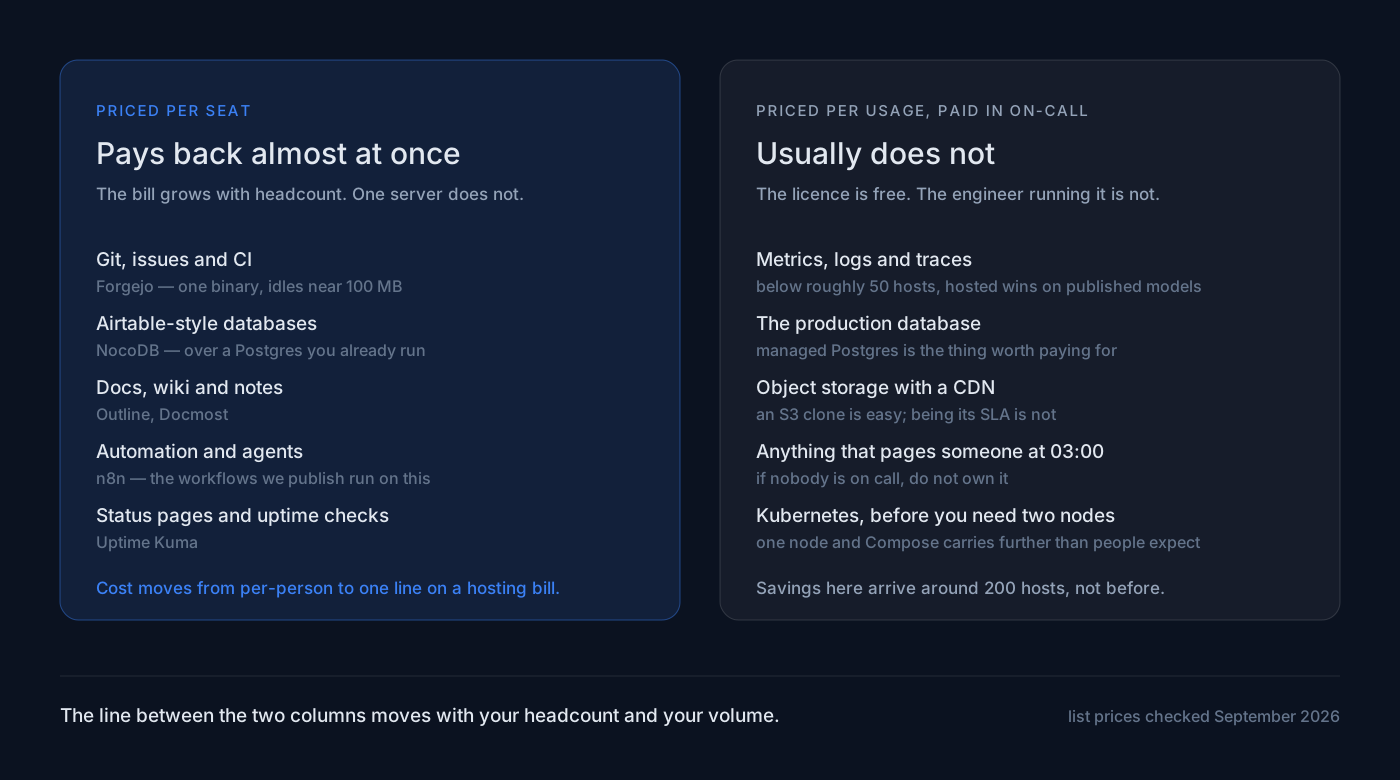
- Git, issues and CI → Forgejo. One Go binary, idling near 100 MB, on the cheapest server you can rent. Workflow files are GitHub Actions-compatible, so `.github/workflows` mostly ports with a path change, and a package registry is built in.
- Airtable-style databases → NocoDB. It puts a spreadsheet interface on a Postgres you already run rather than keeping its own copy. Know that it owns the tables it touches — metadata columns, soft deletes — so a raw SQL query will see rows the grid says are gone.
- Dashboards, metrics and logs → Grafana with Prometheus and Loki. Excellent software. Read the next section before you move it.
- Automations and agents → n8n, self-hosted. Seventy-six of the workflows we run are published, so you can see the shape of the thing before you host it.
- Underneath all of it → PostgreSQL. One database can carry the forge, the tables, the automation state and vector search for a RAG system without four separate services.
What it runs on, and what that actually costs
The same two virtual CPUs and four gigabytes of memory cost about €8 a month at Hetzner and about $24 at DigitalOcean, with 20 TB of European traffic included against 4 TB. On raw compute it is not close.
That gap buys one specific thing, and it is worth naming: DigitalOcean sells a managed Postgres from around $15 a month, with backups, point-in-time recovery and failover included, and Hetzner sells nothing of the kind. If your database matters and nobody on the team wants to own restores, that premium is the cheapest insurance on the list.
Above the server sits the deploy layer. Coolify or Dokploy gives you push-to-deploy, automatic certificates and one-click services on a box you own — roughly the experience you are leaving, without the platform fee. Kubernetes belongs in this picture only once you genuinely run more than one node; before that it is a tax you pay in complexity and pay again every time something breaks at an awkward hour.
What we would talk you out of
Your monitoring, if you are small. The software is free and the operational load is not: published 2026 cost models put self-hosted observability behind hosted below roughly fifty hosts, with the crossover nearer two hundred, because the real line item is between a tenth and one and a half of an engineer. A team of five cannot spend half a person on watching the watchers.
Your production database, unless somebody is genuinely on call for it. And, as a general rule, anything whose failure mode is a person being woken at three in the morning for a tool nobody thanked them for.
We would rather lose half of a migration than hand you a pager. The half that is worth moving is worth moving permanently; the half that is not will quietly cost you more than the invoice you were trying to cancel.
What we would move, and what we would leave
What this case does not claim
This is a map and a costing method, not a report of a migration we ran for a client — we are not publishing one of those, and inventing a saved percentage for a company we have not worked with would be worthless to you anyway. The only infrastructure described here as ours is ours: a private model on our own GPU, a coding agent on our own server, our automations on our own n8n. The prices are public list prices we checked in September 2026 and they will drift; the crossover figures come from published cost models rather than from our own measurements, and we have cited them as such rather than dressing them up as experience.
Bring the actual invoices
Thirty minutes with your real bill is enough to say which lines are worth moving, which are not, and what the move would cost you in attention rather than licences. If the answer is that you should stay where you are, that is the answer you will get.